

Doune Ponds History
The nature and amenity area of Doune Ponds has seen both geological change and land use change in its lifetime. The site is 16 hectares (40 acres) in size with underlying geology of old red sandstone. During the
retreat of the ice following the last ice age 13000 years ago, vast quantities of fluvioglacial sand and gravel from the River Teith were deposited over the area forming undulating ground of limited fertility. In the middle ages the land was used as rough pasture and woodland with some cultivated plots known as ‘The Crofts’ in the east and heathland on the rising ground to the north. It was later owned by The Earls of Moray – now Moray Estates Development Company Ltd.
In the seventeenth century this land, together with land now forming Doune Riggs housing, was utilized for the Doune Fairs as the village was a major center for cattle fairs, being on the junction of several droving roads.
Group. Currently they, Kilmadock Community Council and Moray Estates have negotiated an agreement for the long-term management of this nature reserve with similar objectives to the original 1982 agreement with the Stirling District Council.
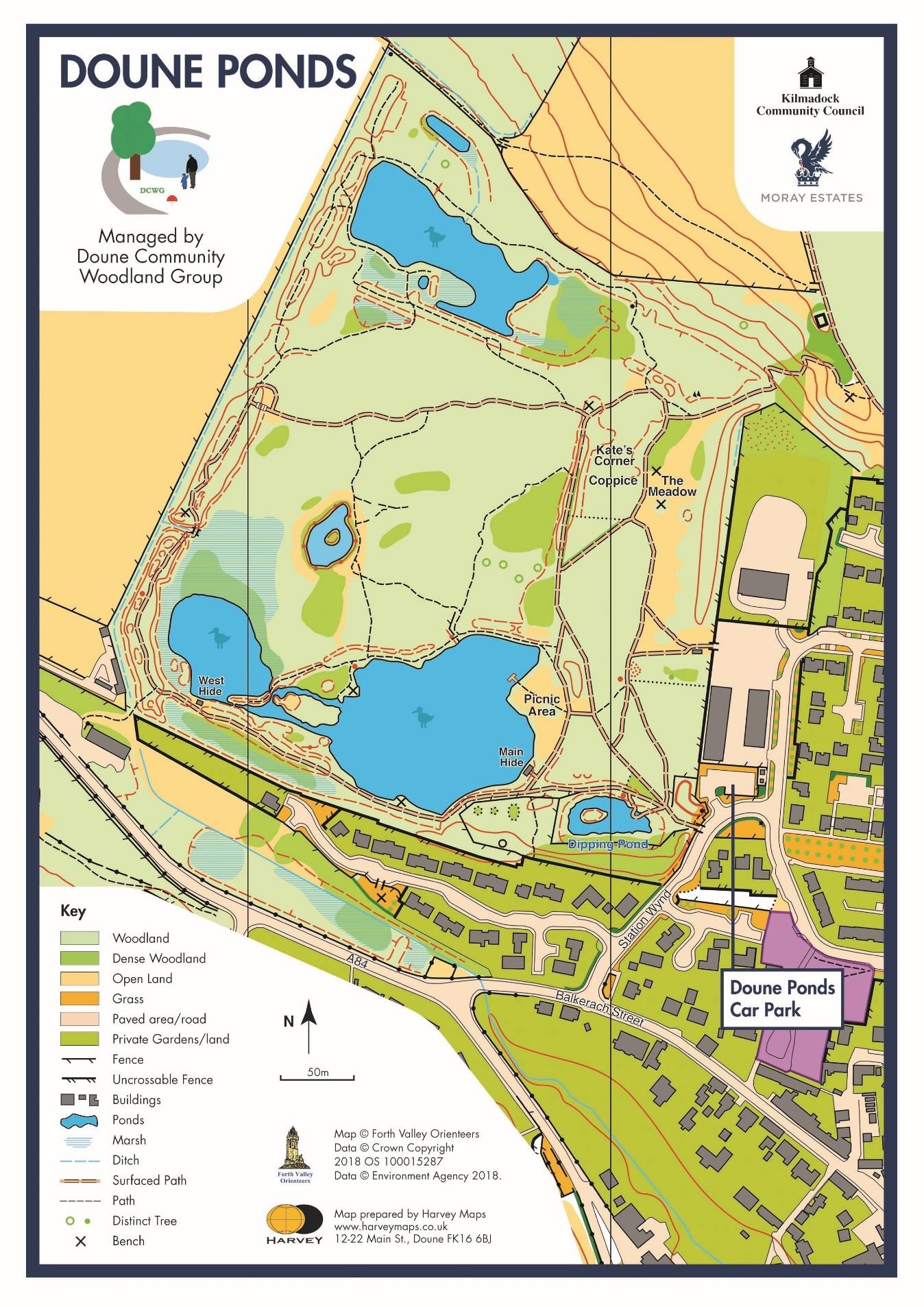
In 1858 the Dunblane to Callander railway was opened, running along the southern boundary of the ponds. This closed in 1965 and was replaced with housing. In 1903 the western part of the ponds was utilized as a part of the Doune Golf Course which operated until the Second World War.
Between 1950 and 1972 a minerals lease between Moray Estates and The Springbank Sand & Gravel Company resulted in most of the extensive sand and gravel deposits in the area being extracted. This covered the whole area of Doune Ponds and included the area now covered by housing. Some of the excavated areas were partly infilled with silt washings as part of the extraction work and later with builders’ rubble and debris.
After excavation ceased the area was not suitable for restoration as good agricultural ground and remained almost unused for 10 years other than some limited tree planting and use by the British Trust for Shooting & Conservation who carried out some planting, fencing and shrub clearance including building the first hide (overlooking the west pond). During this period some informal public access, predominately by dog walkers, established rough paths throughout Doune Ponds area.
In 1982 the landowner entered into a 20-year Access Agreement with Stirling District Council over the area with 3 main aims: The first aim was to restore and develop the site; the second to make provision for public access; the third to encourage nature conservation. These aims allowed the site to become Doune Ponds as we know it today. Over the next few years and with grant aid from The Countryside Commission (now Scottish Natural Heritage) and great help from volunteer groups the Ranger Service carried out a significant amount of tree planting with associated fencing, built the second hide looking over the central pond, constructed a car park at
the entrance, relocated the standing stone nearby and provided disabled access over the eastern part.
However, with decreasing resources available to the Council they were unable to maintain standards and they relinquished responsibility for management in early 2014.
When 150 new houses were built in the period 2012 to 2014 to the east of Doune Ponds, it brought the area right into the heart of the community. It involved the construction of a new car park and the relocation of the standing stone to yet another new position at the entrance.
Following the Council’s withdrawal from management, Moray Estates entered discussions with the Kilmadock Community Council over local community involvement and a steering group of interested local people formed 7 brought forward the project culminating in the formation in October 2014 of the Doune Community Woodland